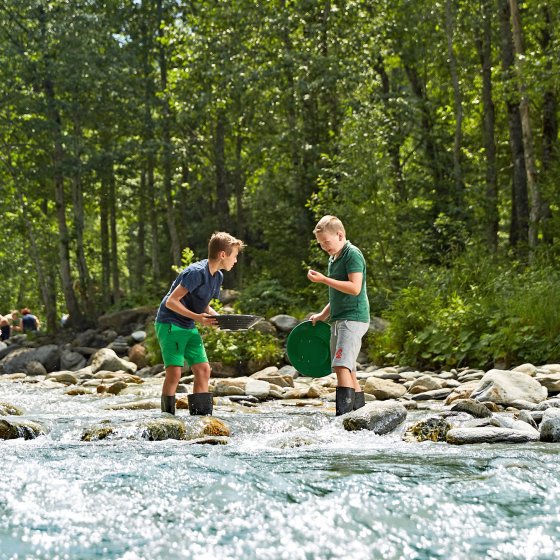
There's one moment we look forward to every summer here at the Rauriserhof: a child kneels at the stream, swirling the pan with total concentration – and then that gasp of delight when a tiny, golden flake suddenly flashes up between the dark sand. That's exactly why so many of our guests come to the Raurisertal.
This valley in Austria's Salzburg region has more than earned its nickname, "the golden valley of the Alps." For centuries, prized Tauern gold was drawn from these mountains, right around what is now the Hohe Tauern National Park. That history is still tangible today – and on your summer holiday, you can experience it with your own hands. Gold panning in Rauris isn't a museum behind glass; it's a genuine encounter with nature for families, the curious, and anyone who wants to leave everyday life behind at the water's edge.
Before you set off, here are the key points that will make your gold-panning day nice and relaxed:
Heimalm: the family-friendly classic
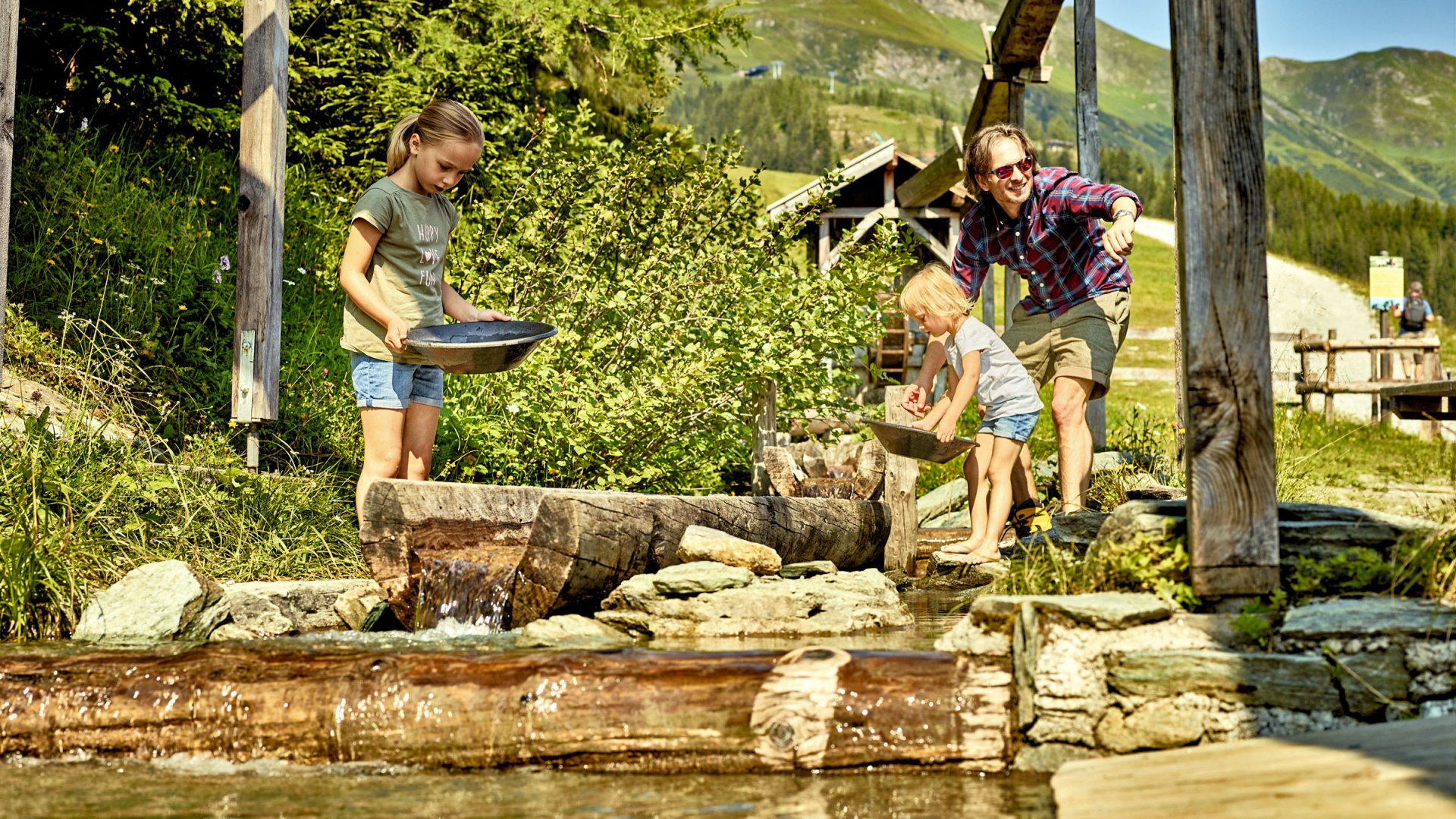
Right at the mid-station of the Rauris Hochalm cable cars lies the gold and mineral panning site at the Heimalm – our tip for families with younger children. Here, an experienced team shows you at an unhurried pace how to separate the light sand from the heavy gold using the classic pan. No prior knowledge required, and nobody leaves empty-handed.
What children love most here: mineral panning with a guaranteed gemstone find, the little play stream to cool off in on hot days, and the mascot Tilly, who keeps things lively with treasure-hunt activities.
Our tip for a full day out: ride the cable car up to the top station and take in the impressive birds-of-prey show at the Hochalm. Afterwards, stroll gently down the Tilly forest nature trail to the Heimalm – and round off the day at the panning site. It's a well-balanced outing that combines mountain railway, nature, and adventure.
Bodenhaus: the untouched experience in the valley basin
About 14 kilometres further on, in the Bucheben area and just past the historic Bodenhaus inn, waits the second site – more natural, quieter, right on the crystal-clear Rauriser Ache river. It's at exactly this spot that the river has always slowed its pace, depositing the finest gold particles in the sand over the centuries. If you're seeking the calm of the Hohe Tauern National Park, this is the place.
Our tip for a full day out: combine your gold panning with a hike through the Kolm Saigurn valley basin – to the legendary Rauris primeval forest, for example, or to the thundering waterfalls. After the walk, the Bodenhaus is the perfect place to rest: feet in the cool water, pan in hand, and just breathe.
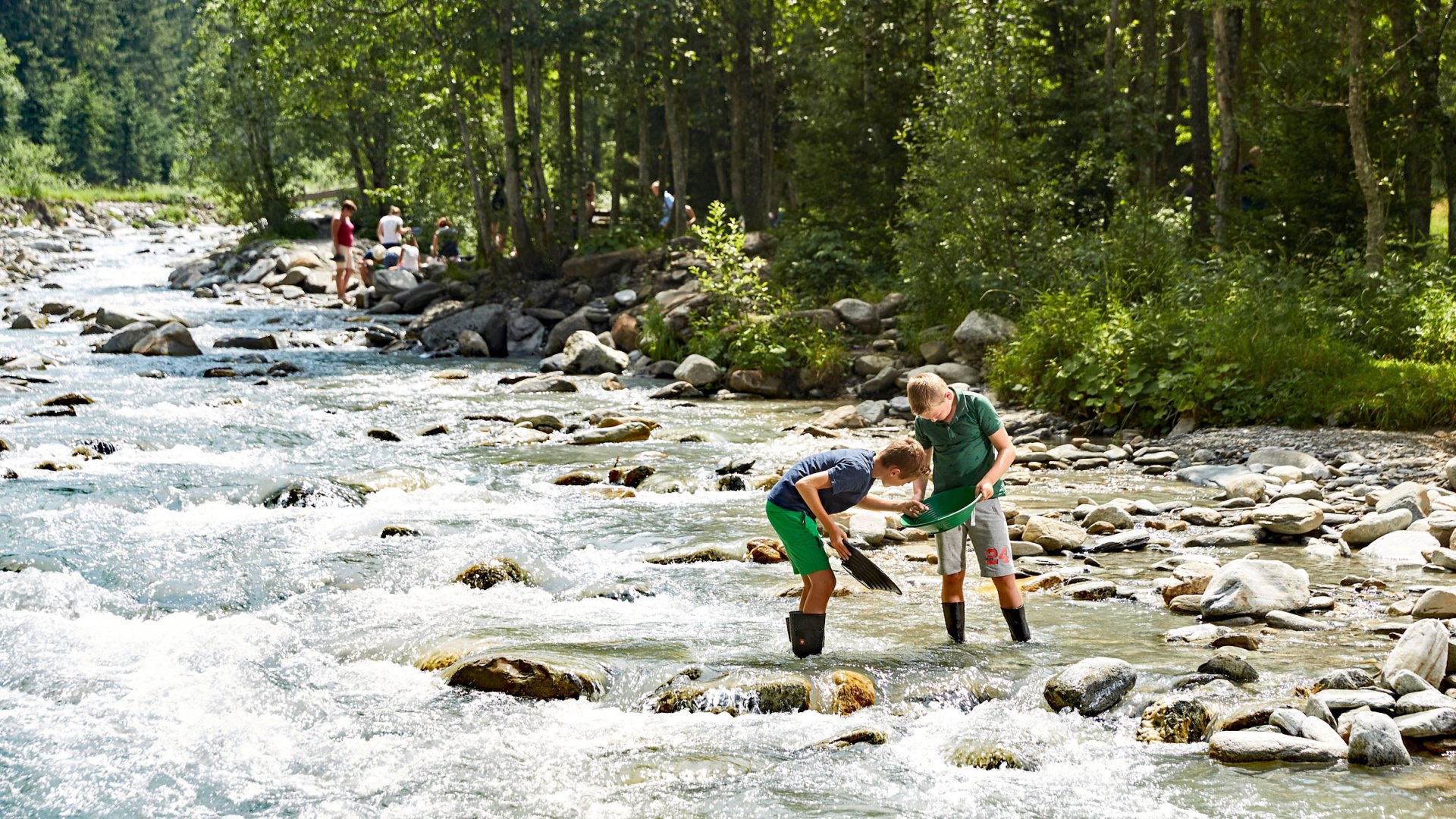

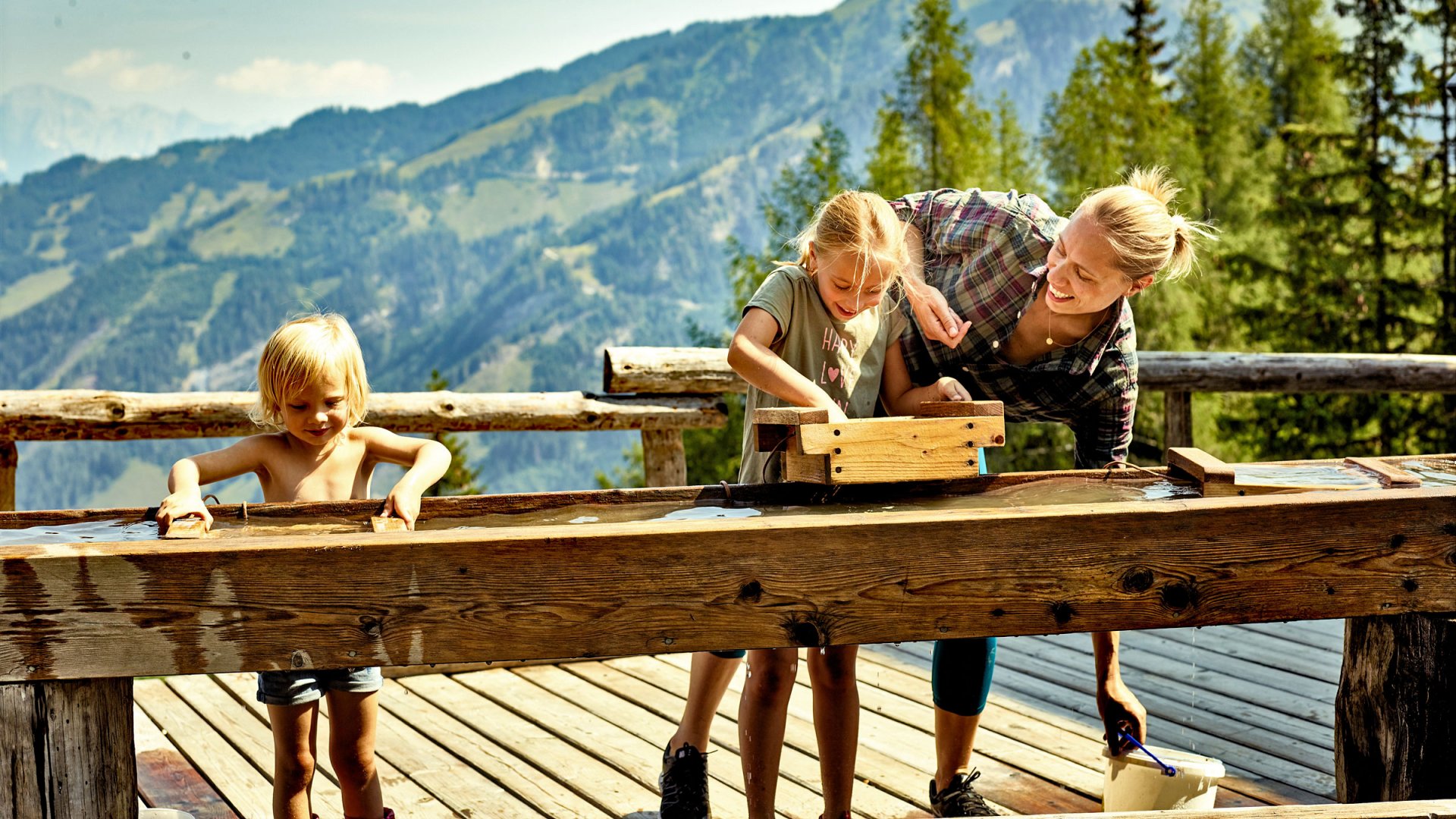
"You have to be able to read the stream," one of our team likes to say. And there's truth in that: anyone who understands which bends and which rock barriers the heavy gold collects behind holds the best cards. But don't worry – the technique itself takes about five minutes to learn:
The best part? It isn't about a quick result. It's about the slow swirling, the glitter in the water, and the small moments of triumph in between.
With us, the gold-panning fun begins right at reception – at no extra cost. That's because the Nationalpark SommerCard Mobil is included in your room rate from the very first night. In practical terms, that means:
And once your gold fever has been satisfied for the day? Then unwind in our spa area or savour regional cuisine on our sun terrace. That's how you combine real adventure with the comfort you've earned on holiday.
The Rauris Valley, known as the "golden valley of the Alps", has two gold panning sites. The Heimalm site is at the middle station of the Rauriser Hochalmbahnen, with a large water wheel and plenty of room for families with younger children. More natural and quieter is the Bodenhaus site at the back of the Rauris Valley, where you pan right in the Hüttwinkler Ache stream, just a few minutes' walk from the car park at Alpengasthof Bodenhaus.
Gold panning takes place in summer, roughly from early June to mid-September. Most recently the Heimalm site opened from 9.30 am to 3.30 pm while the gondola was running, and the Bodenhaus site daily from 10 am to 4 pm, until 5 pm in July and August. The sites close in heavy rain. Our reception has the exact dates for the season.
For Rauriserhof guests, gold panning is usually free. The National Park SommerCard is included in the room rate, and with it you can pan at the Heimalm, gondola ride included. At the Bodenhaus site, the first two hours are free. Without the card you pay an entrance fee on site, which already includes equipment and instruction. More about the card on our National Park SommerCard page.
Yes. Every flake of gold and every pretty stone you find is yours. You'll get a little glass vial for it and can take your find home as a souvenir.
No. You'll get a gold pan, rubber boots and instruction right at the panning site. The principle is simple: fill the pan with gravel and water and swirl it until the sand and light stones are washed away. Gold is around 19 times heavier than water and stays at the bottom, so at the end the fine flakes glitter in your pan.
Yes, children love it. At the Heimalm an experienced team shows you how it's done, there's a gemstone find guarantee when panning for minerals, and the little water-play stream and Tilly the mascot keep things fun. The Bodenhaus site is aimed at children aged around 8 and over and also has a water playground.
Austria's best-known gold deposits are in the Hohe Tauern, above all in the Goldberg group around Rauris and Gastein, where an estimated 120 tonnes of gold are still thought to lie in the mountains. In its heyday around 1500, about a tenth of the world's gold production at the time came from the Rauris and Gastein valleys, and Salzburg was known as the "Peru of the Old World". Today the Rauris Valley is one of the loveliest places to look for Tauern gold yourself.
At the official gold panning sites in Rauris, yes, with no fuss and no permit needed. If you want to look for gold elsewhere in Austria, you need the landowner's consent, the search must be reported to the authorities, and nature conservation and national park laws may restrict it. That's why the panning sites are the nicest and safest way to try your luck.
The Celts and Romans probably already searched for gold in the Rauris Valley. The great age of mining ran from about 1460 to 1560, and around 1550 there were some 450 mines in Rauris. You can still see traces of it today, such as the old miners' houses and tunnels at Kolm Saigurn at the head of the valley.
The Heimalm site combines well with the bird of prey show at the Hochalm, and you can stroll back down to the Heimalm on the Tilly forest trail. From the Bodenhaus site it's not far to Kolm Saigurn, with the Rauris primeval forest and its waterfalls. More about the show on our bird of prey show page.